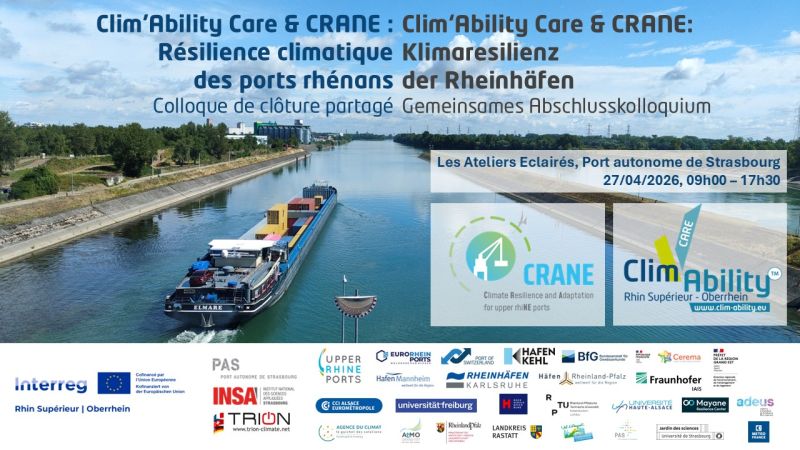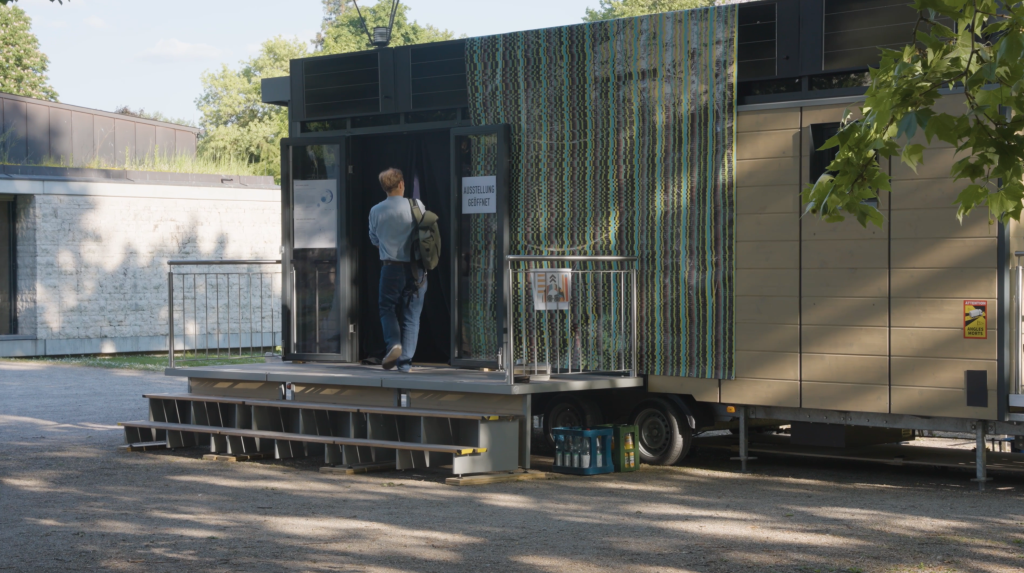
For the past decade, a consortium of around twenty partners has been working to foster a climate culture across the Upper Rhine region (Clim’Ability, Interreg V and VI, 2016–2026).
From supporting industrial stakeholders to building resilient regions, the approach has expanded, project by project, to industrial corridors, thereby incorporating more stakeholders and greater complexity into the search for perspectives and pathways for adapting to climate change.
This exploration took place at the level of pilot sites – Sainte-Marie-aux-Mines, Murgtal and the Port of Strasbourg – which were ready and willing to engage in action research, structured around the identification of territorial vulnerabilities and the exploration of solutions subjected to full-scale trials for validation.
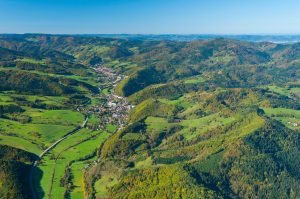
Following this collaborative journey involving researchers, public authorities, associations, hybrid collectives and private stakeholders, we sought to enrich the collective memory of this emblematic region of the Upper Rhine. Indeed, Sainte-Marie-aux-Mines is characterised by its roots in border culture and its cosmopolitanism. Long a border town, straddling a Germanic and French heritage,
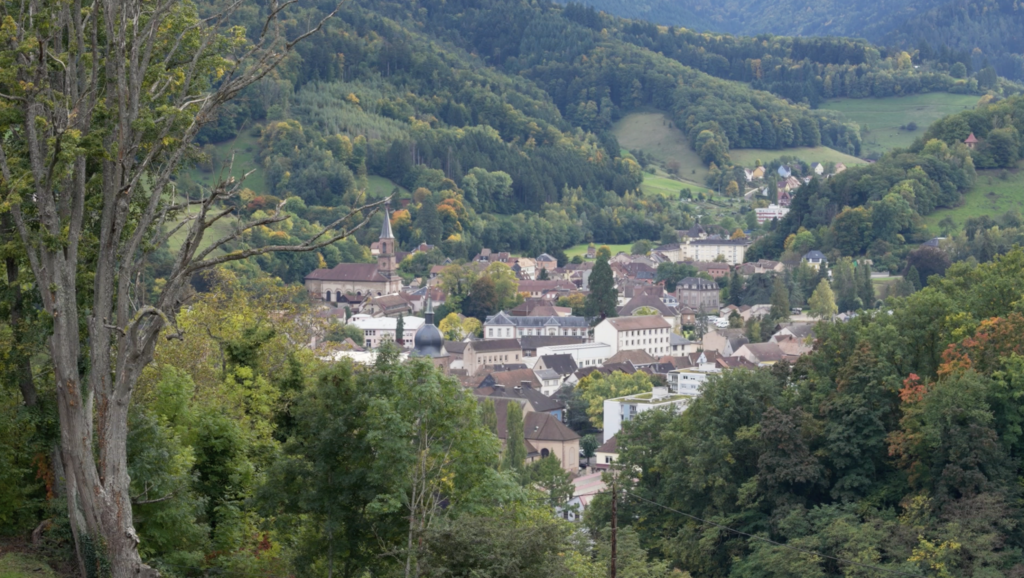
Sainte-Marie-aux-Mines was born of a merger between two communities, evidenced by the construction of footbridges over the River Liepvre which runs through it. From this event, it retains numerous vestiges that underpin its status as a heritage town.
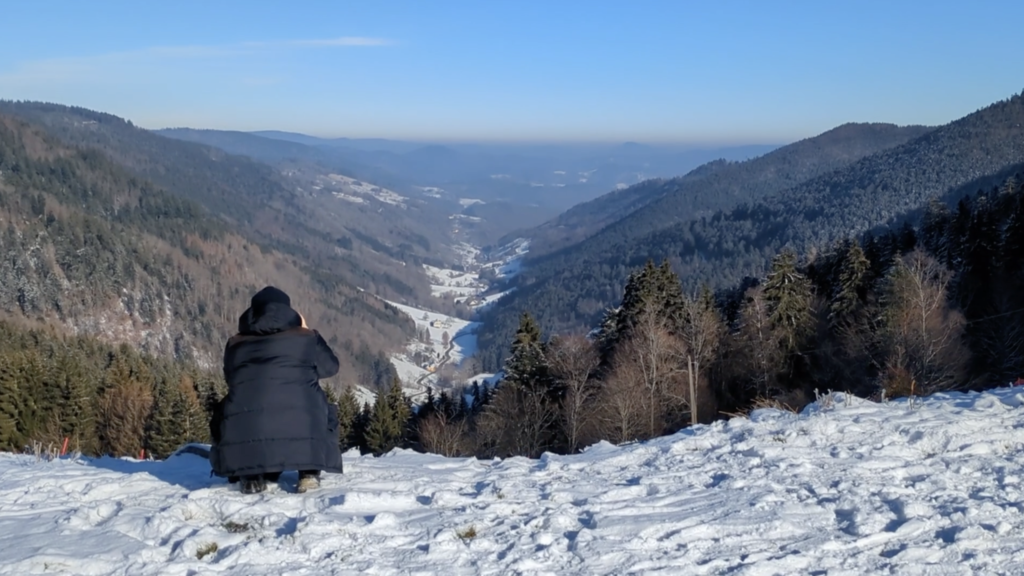
From a prosperous past built on silver mining, the rise of the textile industry and economic migration fuelling the growth of the Trente Glorieuses, Sainte-Marie-aux-Mines has always distinguished itself through its ability to overcome crises and uncertainties. Thus, in response to the decline that began with the first oil crisis, it adopted a strategy of tourism development by promoting its mid-mountain economy and by establishing a small winter resort at the Col de Bagenelles from the 1970s onwards.
It was around this infrastructure, critical to climate change, that the project approached the public authorities of Sainte-Marie-aux-Mines to negotiate a pilot site partnership within the framework of the Clim’Ability Care project. The latter explores how climate change is becoming part of the history of Sainte-Marie-aux-Mines? How is it raising new questions and putting the community to the test with new challenges? Whilst the future of the small resort at the Col de Bagenelles has emerged as one of the critical issues the community must address, the research has gradually shifted this focus—which was limited to the future of a single critical infrastructure—towards a more systemic and holistic vision.
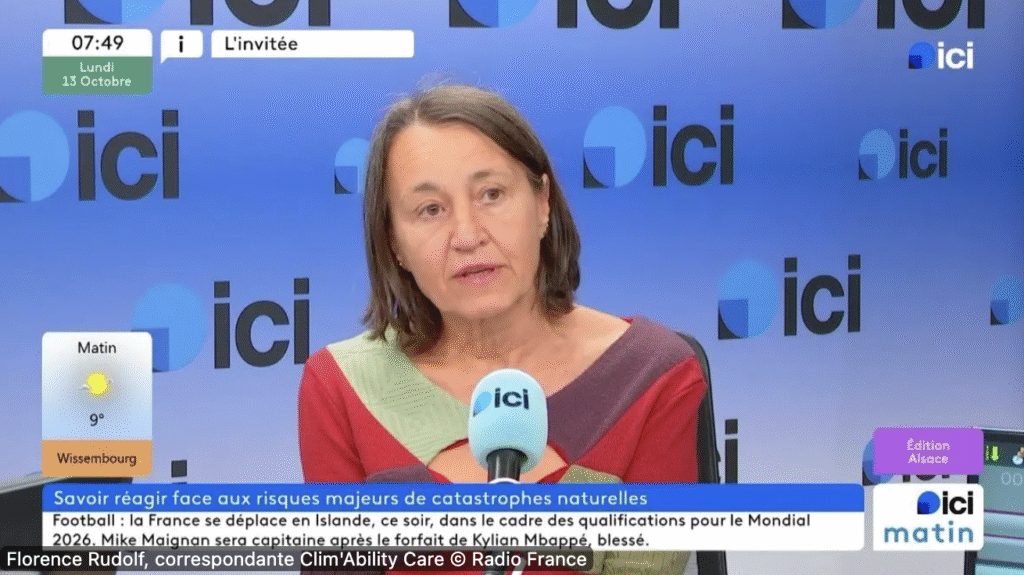
The 10 videos recount key moments of the research through interviews with key stakeholders, including the mayor of Sainte-Marie-aux-Mines (Noëllie Hestin), the archivist of the Val d’Argent community of communes (David Bouvier) and the scientific lead of the Clim’Ability Care project (Florence Rudolf, INSA Strasbourg) and many other testimonies that have informed the project.
Among the numerous resilience pathways outlined based on the decision trees resulting from the inventive design, the main one to have emerged involves greater integration between the town and the Col des Bagenelles on the one hand, and, more generally, stronger pooling of the various existing potentials on the other. This scenario amounts to making the municipality’s notable sites accessible to residents and visitors alike.
This option stems from the observation that today’s vulnerabilities are the legacy of past riches, which should be revitalised through their updating and pooling. This option prompts reflection on mobility, the residential economy, or proposals for the development of discovery trails linked to a seasonal programme (Chantier Éco-Conseil), or even on the more ambitious development of sectors with the potential to create jobs and skills. The scenario outlined relies on cooperation between the various stakeholders in the region. It is through this cooperation that the pathways to regional resilience will take root.